

22 Oct 20 Years. 20 Stories: Built Into the Business
Andrew Squillacioti’s Journey from the Tools to Leadership
For Andrew Squillacioti, Concept AV has never simply been somewhere he worked.
It was part of his childhood long before it became his career.
His earliest memories are not of boardrooms, business strategy or leading teams. They are of being a kid in what seemed like an enormous factory, watching his parents build something he did not yet fully understand.
“I just remember it being this huge sort of factory,” Andrew recalls. “I was a little kid, so it probably wasn’t that big.”
As Concept AV grew, the line between the family business and family life became increasingly blurred. School holidays turned into long days helping his father on projects. Friends were recruited to lend a hand. Projectors, cables and installation work became part of growing up.
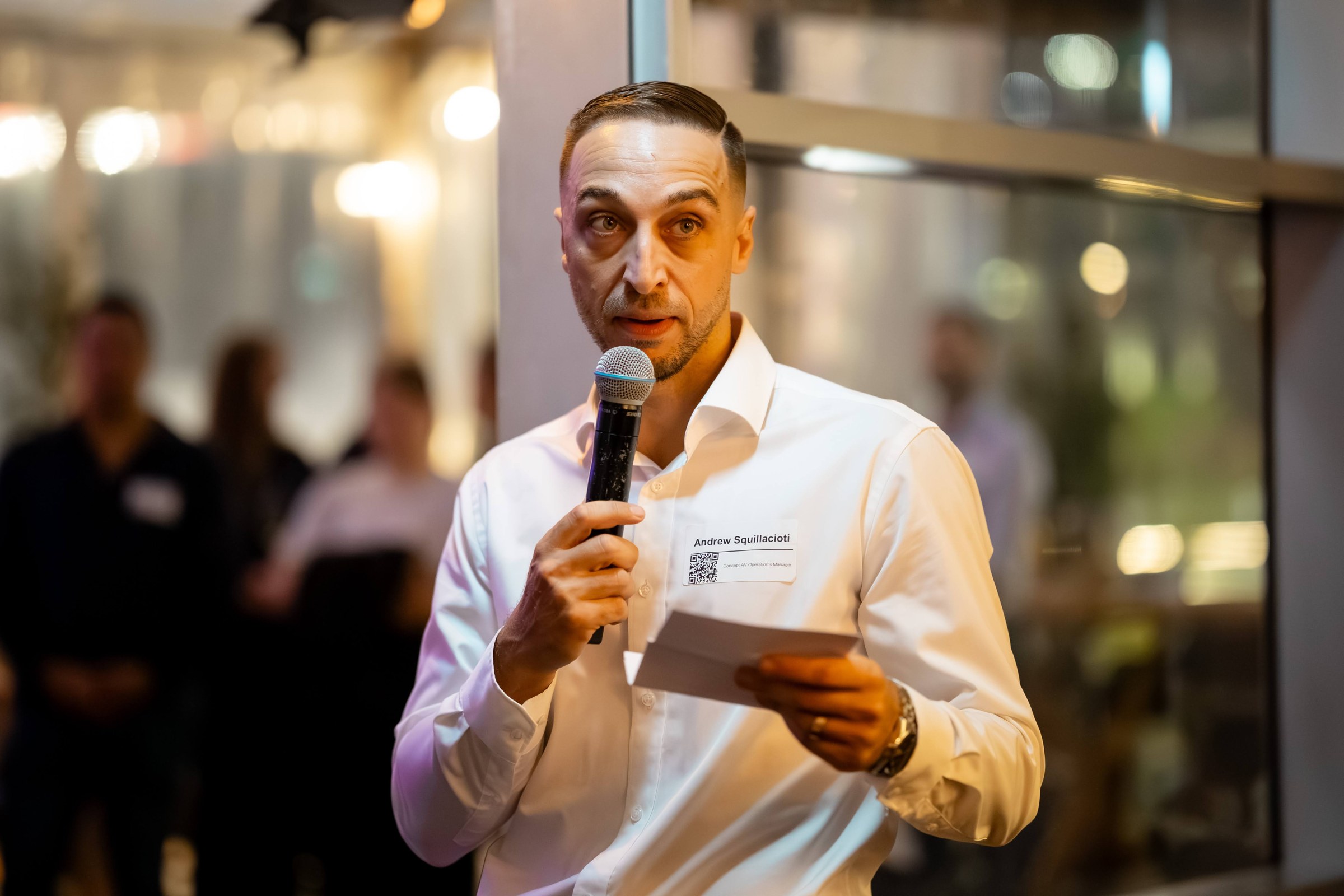
Today, as Chief Executive Officer, Andrew leads the organisation and is shaping what Concept AV will become next.
But the path from one to the other was never intended to be automatic.
Growing up around the business
When Concept AV moved to Homebush, Andrew remembers the business becoming a much bigger part of the family’s everyday life.
A large portion of Concept AV’s work at the time was in schools, where projects had to be completed during narrow holiday windows. That meant intense installation programs, sometimes refreshing dozens of rooms in only a couple of weeks.
Andrew was still at school, but during the holidays, he was often with Tom and the team.
There were 13- and 14-hour days spent swapping projectors, running cables, moving equipment, and doing whatever else was required to get the work finished.
“I was handling thousand-dollar-plus projectors and installing them, and then going to school and using those same projectors during the school year.”
It was also where Andrew first experienced something that would stay important to him throughout his career.
Friends would join the crew during the holidays. Everyone worked hard, but there was a camaraderie around it. Concept AV never felt like work for work’s sake. It felt like people doing something together.
That early experience would later influence the type of culture Andrew wanted to help build as the company grew.
Another influence on Andrew’s understanding of leadership was less visible, but no less important: his mum.
While Tom was often the more visible face of the business, Andrew remembers his mother as the quiet force behind the scenes, keeping the wheels turning and giving others the confidence and support they needed to do their jobs well. Much of what she did went unrecognised or unrewarded; she simply did what needed to be done because the business and the people within it depended on her.
For Andrew, that became an important lesson in what leadership really looks like. It is not always about being the loudest voice in the room or the person receiving the credit. Sometimes it is about creating the conditions for everyone else to succeed. That philosophy can still be seen in the way Andrew leads today, and in the culture Concept AV has worked to preserve as the organisation has grown.
Choosing to earn his place
Despite the family connection, Andrew did not finish school and move immediately into management at Concept AV.
He left to complete an electrical apprenticeship with another company, gaining experience outside the family business and developing a trade of his own.
Eventually, he returned to Concept AV and went back onto the tools, which suited him.
“I was always a real hands-on sort of person,” he says. “I was much more about getting things on the wall and using my hands and making things happen.”
For the next seven years, Andrew worked his way through the installation side of the business. He started as a junior, developed his technical capability and gradually took responsibility for crews and increasingly significant projects.
Throughout that period, one thought remained firmly in the back of his mind. He was Tom’s son, and he did not want that to define how people saw him.
“I really had that thing in my head: I don’t want people to know me just as that, like I was given anything.”
Instead, Andrew wanted to earn each opportunity.
“If I was given an opportunity, I wanted to make sure that I smashed it.”
That attitude meant saying yes to responsibility, including projects that pushed him well beyond simply being technically capable on site.
Learning to lead on the tools
One of those opportunities came around 2015, when Andrew became site foreman for a large university project, at the time one of Concept AV’s largest jobs.
The scale was different from what he had experienced before. Andrew was no longer responsible only for his own work. He had teams to coordinate, deadlines to meet and people with different backgrounds and levels of experience to bring together.
One of those groups was a crew of tradespeople from Italy who were in Australia on working visas.
Communication was not always straightforward, and Andrew quickly learned that leadership could not simply mean telling people what to do. He found that getting the best from a team came through conversation, explaining where he was coming from and helping people understand what everyone was trying to achieve.
It was an early lesson in a leadership style he would continue developing over the years ahead.
Then came another major milestone. In 2018, Concept AV secured the University of Newcastle’s new building, once again one of the largest projects the company had undertaken at the time.
Andrew effectively relocated to Newcastle. Concept AV leased a house, and members of the project team lived there, with around ten people sharing the property on rotation.
The experience reinforced the camaraderie Andrew had grown up around, but it also forced him to develop greater independence.
Away from Sydney and the business’s normal structures, he had to take ownership of decisions and work out how he wanted to lead. Looking back, Andrew admits there are situations he would handle differently today, and that is also why the project mattered, because it gave him room to learn.
“It really led me to have my own sort of ownership on how I wanted to do things and how we could do things.”
For Andrew, Newcastle remains one of the pivotal moments in his development.
The next one would take him away from the tools altogether.
Stepping into the business
As Concept AV grew to around 30-40 people, the demands of running the company were changing.
Following the Newcastle project, Tom’s business partner was stepping away, and more operational responsibility was falling onto Tom.
Andrew saw an opportunity to help.
Moving into an operational management role seemed like a natural progression, but the first attempt did not work perfectly.
Andrew is open about that as he believes he was probably still too immature to fully take ownership of the role.
When the opportunity came again, however, the conversation with his father was different.
“If I’m going to do this, you need to allow me to do it. You need to step back, as well as me step up.”
It was a significant moment for both of them.
For years, people inside Concept AV had naturally gone to Tom when decisions needed to be made. If Andrew was going to genuinely manage operations, that pattern had to change.
Tom had to give him room to make decisions and, importantly, room to make mistakes.
Andrew had to prove he could carry the responsibility.
Within a couple of months, the transition began to work.
Andrew took control of the operational side of the company and reached a point where he felt it was running “pretty much like clockwork” for what the business required at the time.
More importantly, it changed the way he saw himself.
For the first time, Andrew knew he could not only manage a project or installation team. He could help look after the wider business.
A different kind of leadership challenge
Then COVID arrived. Suddenly, operating Concept AV meant dealing with challenges nobody had planned for. There was work capacity to manage, projects to keep moving, government requirements to understand, site access restrictions to navigate and an entire team whose safety and livelihoods had to be considered.
For Andrew, it was a steep learning curve, but it also accelerated his development as a leader.
After years of solving physical and technical problems, his role increasingly became about solving organisational ones.
- How could the company keep people working?
- How should projects be resourced?
- How could timelines be managed differently?
- How could the business protect the culture that had helped get it to this point?
One issue had been on Andrew’s mind since his own time on the tools.
Concept AV had built its reputation through an enormous amount of effort. When deadlines demanded it, people stayed late. Teams worked weekends. Everyone, including project managers, engineers and Tom himself, would jump in to get a project across the line.
Andrew understood the mentality because he had lived it, but as the company matured, he wanted to reduce the personal cost that came with it.
“One of the goals I internally set myself was I wanted to give my install team their weekends back, or their personal lives back.”
That did not mean Concept AV would never work evenings or weekends. In AV, some out-of-hours work is unavoidable.
The goal was to plan it rather than normalise it.
If weekend work was coming, Andrew wanted people to know in advance so they could plan their lives around it. It was a small example of a much larger idea: the company could continue lifting its standards without losing sight of the people doing the work.
From running the business to shaping it
Today, Andrew’s role has shifted again. Concept AV has developed a stronger leadership structure, with experienced people taking ownership across different areas of the company.
For Andrew, that means recognising that the best answer will not always come from him.
As he has moved further away from some of the day-to-day work, the people closest to it often have stronger insight.
“My insights may not be as strong as somebody who is closer to that.”
That understanding has shaped the way Andrew now approaches leadership.
Rather than trying to control every decision, his focus is increasingly on putting strong people in the right positions, listening to their expertise and creating the structure they need to make good decisions.
It has also given him more time to consider a much bigger question.
Where should Concept AV go next?
Looking beyond the meeting room
Andrew believes standing still is one of the biggest risks facing any technology business.
“Our industry technology changes. If we’re not changing with it, it’s going to leave us behind.”
But for him, keeping pace is not enough.
“One of the terms that I do like to use is we evolve.”
That means thinking further ahead than the next product or trend.
“We try to look at what’s two or three, four iterations ahead of that.”
The philosophy is increasingly shaping Concept AV’s direction.
Historically, much of the AV industry has centred on individual spaces: the boardroom, meeting room, training room or presentation space.
Andrew believes Concept AV can influence something much larger. Rather than creating an excellent technology experience in one isolated part of an office, he wants the company to consider the wider workspace and how people move, communicate, and collaborate across it.
The goal is not technology for technology’s sake; it is improving the way people work.
That has also changed the type of conversations Concept AV wants to have with customers.
Instead of simply receiving a tender, delivering the specification and moving on, Andrew wants the company involved earlier.
Concept AV is already participating in more proof-of-concept work and broader discussions with customers about what they actually want their technology and workplaces to achieve.
“We’re here for the journey and to help and to be part of that organisation to understand what’s best for them.”
For Andrew, technology only becomes valuable when it is aligned with the right objective.
As he puts it simply:
“A cord is only as useful as the thing it’s plugged into.”
Thinking beyond handover
Another important part of that future is service.
Andrew wants Concept AV to think about the entire lifecycle of the technology it delivers, not simply whether everything works when a project is handed over.
Technology changes. Products fail. Rooms evolve. Users need support.
That means serviceability needs to be considered from the beginning.
It is also why Concept AV wants to become involved earlier with architects, designers, consultants and other project stakeholders. A beautifully recessed display might look perfect on opening day, but what happens when that model reaches end of life? Can it be replaced without compromising the wall? Can technicians easily access the equipment behind it?
Historically, an integrator may have been brought in after those decisions had already been made.
Andrew wants Concept AV to help ask those questions sooner.
Not to replace the other specialists involved, but to contribute to a better overall outcome.
It represents the shift he sees happening across the business: from being a company that is told to “go and do”, to one that can be part of the entire journey.

A career built from the ground up
Despite spending less time physically installing systems today, Andrew’s enthusiasm for the technical side of AV has not disappeared. If anything, his appreciation has grown.
He remembers the difference between his electrical apprenticeship and the satisfaction he later found in AV. With AV, all the pieces eventually come together.
“You throw a few TVs on the wall, you put eight cameras up and a touch panel, and then you press the on button and join a meeting. And then everything comes to life.”
That moment still captures what he loves about the industry.
It combines construction, technology, engineering, problem-solving and user experience into something immediately visible.
It is also why Andrew is particular about the people Concept AV brings into the industry.
“It’s not a job, it’s my career.”
For him, that distinction matters.
AV can be difficult. Technology changes quickly, and the problems are rarely repetitive. But for people who are genuinely curious about it, Andrew believes that challenge is exactly what makes the industry rewarding.
“If this is a career, and you give it 100%, then you’ll get a lot of satisfaction from a job like this.”
Andrew’s own career is evidence of that. He started as a kid helping during the school holidays. He left and completed an apprenticeship. He came back and spent the better part of a decade on the tools.
He led teams, relocated for major projects, stepped into operations, navigated COVID, and gradually took greater responsibility for the organisation’s direction.
Now, he is helping Concept AV prepare for what comes next.
And while the scale of the questions has changed, much of the mentality has not.
Understand what needs to happen. Bring the right people together. Take ownership.
And keep evolving.